
You typically feel "fine" in most situations.
Updates with peers... no problem.
Chit-chat with colleagues... pretty easy.
Maybe there are times when there's "a little bit of nerves" but always manageable.
But here's when the nerves hit hardest:
- presenting to senior leaders
- when your boss shows up to the meeting
- speaking up in meetings with leaders present
- fielding questions you didn't expect from those above you
- feeling challenged or getting push back on your ideas or work
- presenting something that could be judged or criticized
In those moments, your brain feels the pressure to handle the moment well.
Because if you don't...
you feel like your credibility and how people see you will take a hit.
And that's what creates the nerves.
And by the way... you are completely normal when you feel this.
This desire to be seen as credible and maintain social standing is 100% wired into your DNA. Status matters. Reputation matters.
This is why 90% of people feel nerves in front of their leaders or in high-stakes meetings and conversations.
You're feeling... "this could change how I'm seen."
Again, you're normal, but what do you do about it?!

Most Advice Fails to solve the reputation risk:
Most speaking advice focuses on things like:
- being more prepared
- getting your content right
- "fake it till you make it!"
- positive affirmations
- deep breathing exercises
- bringing more energy
But these exercises alone don't address your problem at the root fear of losing reputation.
And let's be honest, how often do you really feel "prepared enough" for a presentation or off the cuff question at work?
Time is a luxury we don't have.
And there's probably been a time you were prepared and you still felt the nerves and anxiety right before you spoke.
And when your brain senses the risk... the nerves spike.
That means every high-stakes moment feels harder than it should.
And over time, when you don't handle your opportunities well, it can absolutely impact how you're seen and talked about at work.
So what do you do?
How do you overcome the nerves and spike in anxiety that's causing the shakiness and uncertainty?
There's a simple 3 part solution.
Step 1: Understand What's Happening
in Your Body
When you feel reputation risk, your brain instantaneously activates your fight or flight response - aka your amygdala.
Your amygdala is the biological system in your brain designed to protect you. It detects "threats" so fast, your body reacts before your brain even knows what hit it.
Now you may be thinking "but I'm not in physical danger!" True.
But your brain also detects and reacts to social danger the exact same way.
It's literally hard-wired into your design.
The more risk it detects, the harder it responds looking for "a way out."
And in speaking and being cornered with an unexpected question, you can't just walk out!
Think about it, when you feel underprepared, you're nervous...
But really you're nervous of what being unprepared will do to how people see you at work.
This is why stress and pressure at work, at it's root... isn't about stress and pressure.
It's about the anxiety of losing reputation in the eyes of your team and your leaders.
This explains why highly capable professionals like yourself suddenly experience symptoms in high-stakes moments:
- The heart pounding.
- Adrenaline pumping.
- The voice shaking.
It's because the amygdala in your brain is saying "get out! This could change how people see you."
That... is what reputation risk does to your body.
And understanding this is the first step to solving the problem.

Step 2: Win The Mindset Game
This is the layer we've seen every communication training ignore.
It's not "positive affirmations".
It's not "be more prepared."
In high-stakes moments, most professionals have thoughts like:
“Am I explaining this well enough?”
“What if I get push back?"
"What if I don’t handle this well?”
“Will I look like I know what I’m talking about?”
“Will they see me as credible?”
This inner dialogue fuels the pressure… the adrenaline… the shaky voice… and the nerves.
This is why at Speaking Up Your Game, we say you need a mental system that dials down the pressure by reducing the focus on yourself.
You need a mental system that changes how you experience these moments.
So instead of:
- second-guessing your prep
- second-guessing your wording
- spending endless hours preparing
- overthinking every detail
- feeling shaky and unsure as you start
or worrying about how you're being judged
You can learn specific skills to:
- reduce the anxiety onslaught
- show up and stay calm
- think clearly on their feet
- and deliver calmly and confidently
Then, when the pressure rises, you don’t freeze.
You step into the moment and crush it which leads to getting what you wanted.
The "You nailed that!"
And less nerves in the future
because you've done it successfully.
And you accelerate your visibility and conversations around "Hey, what's next for your career?"

Before Step 3: Two Key Insights from High Performance Psychology
Performance coaches and sports psychologists discovered something critical to high-stakes performances.
People perform best when they dial down the focus on themselves and instead, lock in on a clear, repeatable routine.
Not the crowd.
Not the pressure.
Not what's at stake.
A clear routine they can follow so your brain can lessen its focus on the risk.
See your body won’t fully calm down until your brain stops scanning for risk.
And when your focus is on:
“How am I doing?”
“What do they think of me?”
“What’s at stake?”
Your brain stays in threat mode.
But when you redirect your focus to something specific and controllable:
“Here’s what I need to do.”
Your amygdala shifts away from the threat… and your body follows.

Step 3: Focus on the Right Task... Giving Value > Judging Performance
In professional communication, the task to execute is simpler than you think:
Deliver value when you speak.
That’s it.
The reason most professionals get nervous is they don’t have a game plan to do just that when the moment hits.
More specifically, busy professionals don't have a game plan to shift their focus off themselves, thus reducing their nerves and to stay focused on serving their audience by bringing value, especially in front of senior audiences and executives.
So instead, your brain and body feels this overwhelming risk walking in and when the unexpected question comes.
But high performers understand how to serve senior leaders and are able to shift their focus.
Instead of getting stuck in their own head, they shift to:
"How can I serve right now?"
“What do they need and want to know?”
“How can I make this useful and helpful for them?”
And when that shift happens… your brain is no longer focusing on the risk...
It’s focused on serving and delivering value.
And then your body settles.
And you can speak calmly and clearly.
And deliver confidently.
The Unique Framework for Quieting the Nerves AND Speaking Confidently at Work
Consistently showing up anxiety free, confidently and impactfully at work comes down to these 3 things.
Understand the Root
Know where anxiety really stems from
Win the Mental Game
Intentionally dial down the focus on yourself.
Bring Value
Serve your audience and the nerves dissipate.
This becomes the foundational game plan you can rely on to show up calm, ready to nail it and stay calm when the curve ball comes... because we all know... the curveball is coming.
Imagine This
↓
My Story...
Hey there, my name is Cooper Camak, and I lead Speaking Up Your Game. I know this pattern well… because I lived it.
For years at Coca-Cola, I was good at my job and generally a capable communicator.
I worked hard.
I knew my stuff.
I loved my work.
But when it came to presenting to leaders…
giving updates in important meetings…
My nerves would skyrocket. My prep would take 3 times longer than it should.
I’d over analyze everything…
second-guess everything…
my slides, my answers...
and I wasn’t showing up the way I needed to.
I spent years trying to "fake it" till I felt like I belonged and trying to “be more confident.”
It never came.
Preparing more.
Thinking more.
Trying to get it right.
Nothing ever changed.
I thought the high nerves in high stakes was just my place in life.
And what I eventually realized was this:
It wasn't a "lack of confidence". It was that every time I spoke in those moments…
My brain was secretly focused on "how they see me.”
And my body shook and trembled because of it.
Once I understood that I was focusing on myself…
I stopped trying to “be more confident.”
And instead focused on:
reducing the focus on me…
delivering value to my audience by
getting clear on my message…
ensuring I tied back to what mattered to them
and delivering clearly.
I shifted my focus away from "what's at stake" and started focusing on "the value" to the audience, and connecting to that purpose.
It was the unlock that changed everything.
Eventually in 2018, after mentoring presenters at Coca-Cola for a year, I started offering 1:1 coaching.
Today, I've coached over 300 people 1:1, sold our signature Confidence & Credibility System countless times and done workshops for another 1,000+ busy professionals like yourself.
About 3 years ago, I stepped back and realized I was teaching the same mindset strategy and speaking formula over and over.
1) How to shift your focus off yourself.
2) How to bring value to senior audiences.
3) How to speak so your message comes across clear and confident.
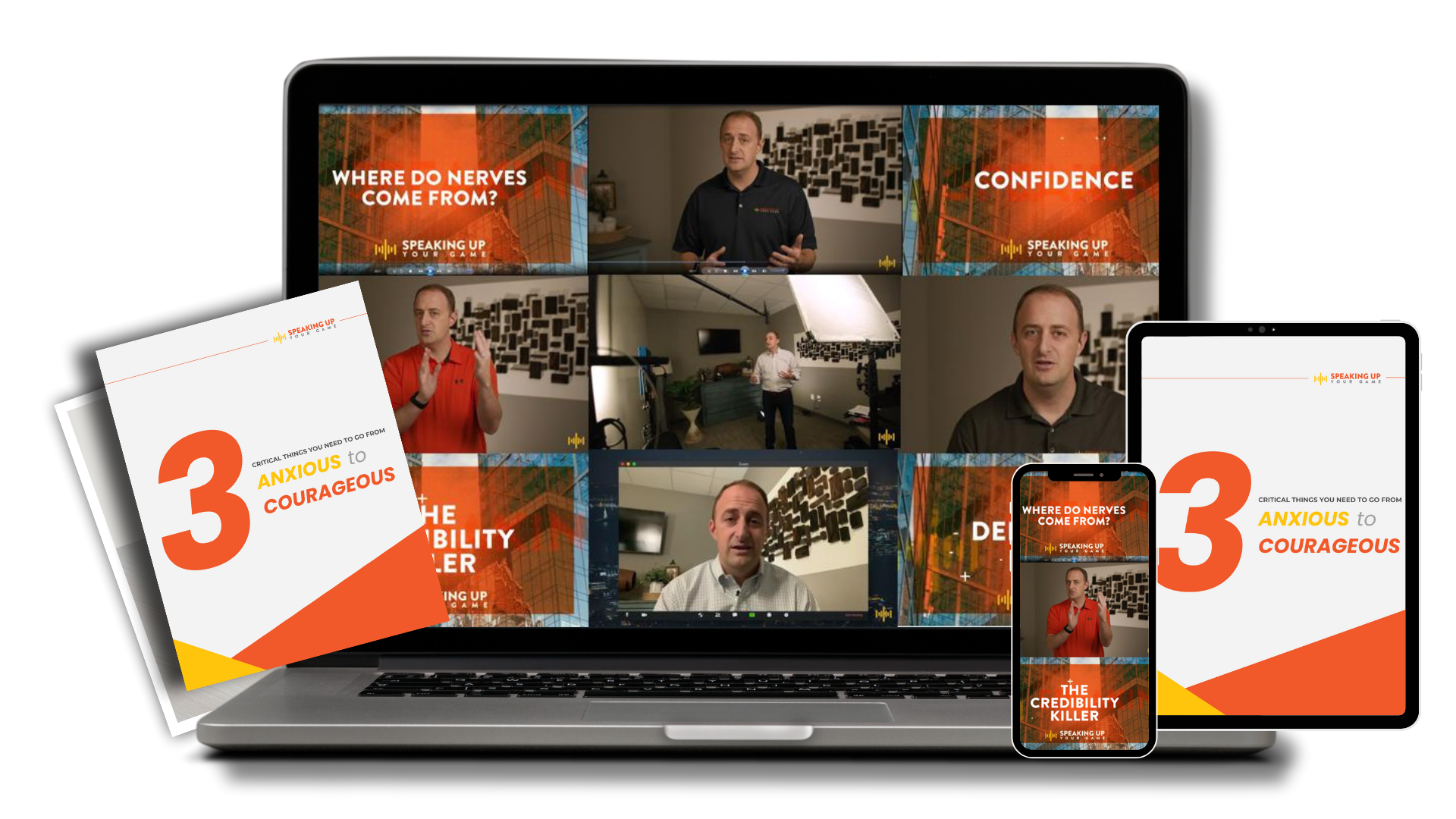
So we turned our coaching lessons into a System.
What You Get
This System includes the two critical sections you need to overcome speaking nerves permanently:
MODULE 1
Winning the Mental Game: Quieting Your Nerves at the Root
- The simple mental model that settles your nerves and shifts your focus.
- Understanding where you feel reputation risk that can trigger anxiety.
- How to stop the racing fear spiral that cripples you from preparing effectively.
- How to calm your brain and your body in 20 seconds.
- How to quiet the negative self-talk and imposter syndrome so you can quit second guessing everything.
MODULE 2
How to Be Clear & Relevant Every Time You Speak
- Never Fear Blanking Out Again
- Learn the Simple Presentation & Meeting Opening Framework that Cuts Your Nerves in Half
- Access to our Presentation Creation Template to craft clear, impactful messages that resonate with your audience.
MODULE 3
How to Deliver Like a Pro – The Foundational Approach
- People overthink public speaking and how to "sound credible." In this module, we teach what "credibility" sounds like. You'll be shocked at how simple it is.
- Learn the essential elements of delivery that ensure you command the room and leave a lasting impression.
- Build consistent confidence by mastering the critical techniques that matter. No more 'overhyped' voice or 'pretending to be something you're not'.
MODULE 4
How to Stay Calm in Off-the-Cuff Moments and Unexpected Q&A Sessions With Leaders
- Learn the secret frameworks Stanford professors teach that help you stay calm and answer executives clearly and concisely.
- Know how to navigate tricky questions (and questions you don't understand) in a way that helps you stay relaxed.
- Stop the rambling by learning the simple formula to being concise and on point.
MODULE 5
The Prep Strategy to Help You Sleep Great the Night Before and Walk-In Calm to Big Moments
- Most people prepare the wrong way. We teach you the strategy to help you sleep well and wake up excited.
- Never Fear Blanking Out or Freezing Again
- Learn the trick to walking in calm and capture engagement quickly from leaders.
Together these modules give you a repeatable system for quieting the nerves and overcoming the reputation risk when it matters most. So instead of feeling anxiety, you can prepare quickly, show up calm, relaxed and credible so you can keep your career moving.
Our Guarantee
The program includes a 30-day money-back guarantee.

If you go through the program and feel like it doesn’t help you communicate with less nerves and more confidence in high stakes moments, just email us and we'll process it immediately.
Here's What You Get to Start Building Your Confidence Today!
The Confidence & Credibility Online System: $449
Right Now Just $299!
- Self-Paced Proven 3-week Program!
- Get PAST the nerves!
- Become confident!
- Accelerate Your Career!
- Gain control when you speak!
- Reduce the Anxiety When Called On
- Learn to Be Clear & Relevant When You Speak
- Deliver Like a Pro
- Lifetime Course Access
- 100% 30-Day Money Back Guarantee
Real-Life Examples
The Cost of Doing Nothing
At this point, you know what it takes. It's been given to you.
Now, you have two options.
You can continue approaching high-stakes conversations the same way you always have...
hoping the nerves go away.
Or you can learn a repeatable system that helps you turn down the nerves and deliver confidently on repeat when the pressure is on.
One path keeps the same cycle going.
The other helps you change the direction of your life and career.